
The short answer
Choose a provider who can show relevant delivered work, explain the proposed scope and agree how the finished website will be tested and handed over. Compare those details before comparing the totals.
A redesigned website can look impressive in a presentation and still create new problems once it goes live. A contact form may stop notifying the right team. An important service page may disappear. The business may discover that it cannot edit its own content without paying for each small change.
When choosing a redesign company, ask more than whether you like the portfolio. Ask how the team will understand your business, preserve what already works, and prove that the finished website is ready to use.
Start with the business problem
Before comparing agencies, identify why you are considering a redesign. Are customers confused about your services? Is the mobile website difficult to use? Is the site outdated, but technically stable? Are you missing enquiries? Or is the underlying CMS difficult to maintain?
A useful agency will help clarify the problem before proposing a solution. If your main issue is a broken form or a slow template, a full redesign might not be the first expense to make.
Ask to see projects similar to your situation
A portfolio should help answer three questions: What problem did the client have? What did the agency actually deliver? What is verifiably different afterward?
For a professional services website, look for clear practice or service pages, credible team information and an easy enquiry journey. For a business with complex operations, check whether the developer has implemented the workflows and integrations you need.
Screenshots show the visual result. A useful case study also explains the requirements, delivered work and limits of the evidence. Be cautious of unsupported traffic, speed or revenue claims.
For example, the Yukt Law case study describes a website update with hosting, SSL and continuing care. Its supplied mobile lab tests have separate test conditions and do not measure enquiry growth. Use a case study to ask which responsibilities are relevant to your own project.
Reading portfolio evidence
Look closely. Then ask for proof.
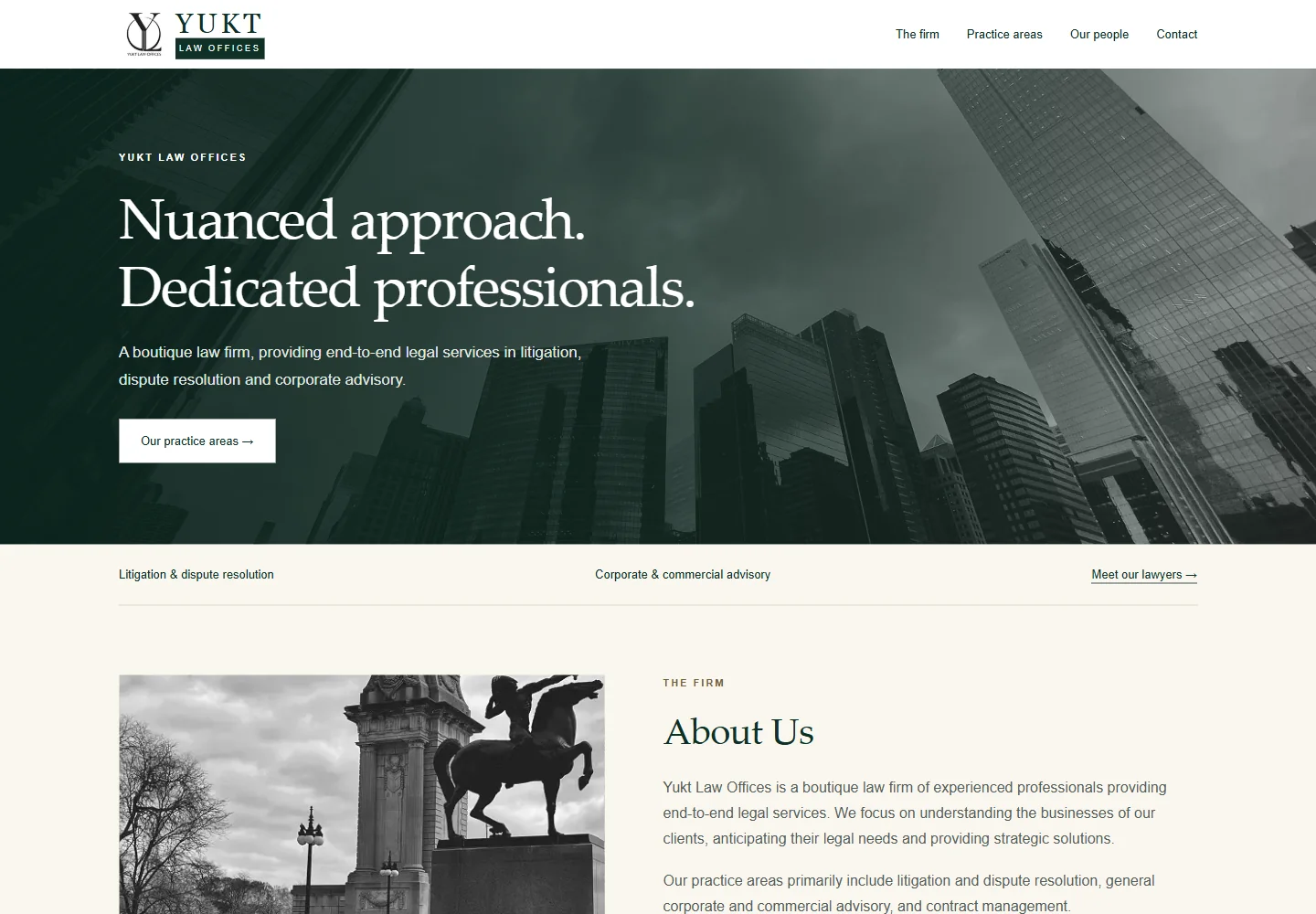
- Find the service
Practice-area navigation is visible.
- See the next step
The hero links to practice areas.
Request alongside the portfolio
- Written scope
- Test evidence
- Ownership details
Compare the full scope
Ask each provider to identify the included pages, reusable templates, content writing responsibilities, integrations, mobile checks, number of revisions, migration tasks, deployment arrangements and post-launch support.
If one proposal excludes content migration and testing while another includes them, the totals do not describe equivalent work. Ask about change requests, payment milestones and acceptance criteria before signing.
Ask what happens to your current search visibility
An existing website may already receive valuable traffic. The redesign plan should identify important URLs and content worth preserving. If addresses must change, the agency should document how old URLs map to the new ones, implement appropriate redirects and check them after launch.
No agency can guarantee stable Google rankings during a substantial site change. A responsible migration process reduces avoidable problems and makes it easier to investigate unexpected changes. Google's guidance recommends testing new pages, mapping URLs and monitoring a move.
Make enquiry handling part of acceptance testing
Ask what happens after a visitor submits a form. Does the correct person receive the message? Is there a confirmation? Can your team distinguish spam from legitimate enquiries? If information is passed to a CRM, does the record appear correctly?
Before sign-off, test these journeys on desktop and mobile. A business website is not complete merely because the design is approved.
Confirm account access and ownership
Document who controls the domain, hosting, CMS, analytics, code repository and other services. Ask what will be provided at handover and whether ongoing subscriptions are required. Some platforms have legitimate restrictions or recurring fees; what matters is knowing them before committing.
Review the team's post-launch process
A provider should explain how defects are reported, whether a warranty or stabilization period exists, who applies security updates and what maintenance is optional. The size of the agency does not tell you whether the process is reliable.
Keep a record of the evidence
| Area | Evidence to ask for | Record your decision |
|---|---|---|
| Similar work | A case study showing the provider's actual role | Relevant, partly relevant or not shown |
| Delivery | Written scope and acceptance checks | Included, excluded or unclear |
| Enquiry handling | A test of receipt, reply handling and any integration | Verified, planned or not defined |
| Handover | Account access, files and recurring costs | Agreed or still open |
| Support | Reporting route and agreed support boundaries | Agreed or still open |
This is a proposed evaluation worksheet, not a score or ranking of any agency. The redesign brief checklist covers the scope information to prepare before asking for proposals.
Questions to ask each provider
Rate each company against evidence rather than impressive language:
- Can they explain your business problem in plain language?
- Do they show work relevant to your website type?
- Is the proposed scope detailed enough to compare?
- Is content ownership and approval assigned?
- Are existing URLs and search risks addressed?
- Are forms, integrations and mobile journeys tested?
- Are accounts, source materials and recurring costs clear?
- Is there a realistic post-launch support plan?
If several answers remain unclear, ask for written clarification rather than assuming they are included.
When a smaller project is the better first step
Not every business needs to commission a full redesign immediately. A short audit may reveal that more useful service content, simplified navigation or a repaired enquiry flow would deliver the first improvement. Other websites genuinely need a coordinated redesign or technical rebuild.
Choose a provider whose evidence and written commitments match your requirements. A good redesign should be useful to customers, manageable for staff, and sustainable after launch.
Tell us about your project
Start with your details. We’ll discuss the right next step.
Discuss the next step
Explore WebBuild Website Redesign and use the existing redesign brief checklist to prepare your requirements.
Questions covered in this guide
Do I need a complete redesign before choosing a provider?
Ask for a diagnosis first. A focused repair may be enough when the current platform and structure still serve the business.
What should I compare besides the price?
Compare relevant delivery evidence, scope, testing, ownership, recurring costs and agreed support responsibilities.
Sources and project context
- Google Search Central: site moves with URL changes Checked 7 November 2026
- WebBuild: Yukt Law case study Checked 7 November 2026
- Yukt Law Offices: redesign and continuing website care Web Build Solutions project record
Turn the question into a clear next step.
Tell us about your current setup, the people using it and what needs to improve.