The short answer
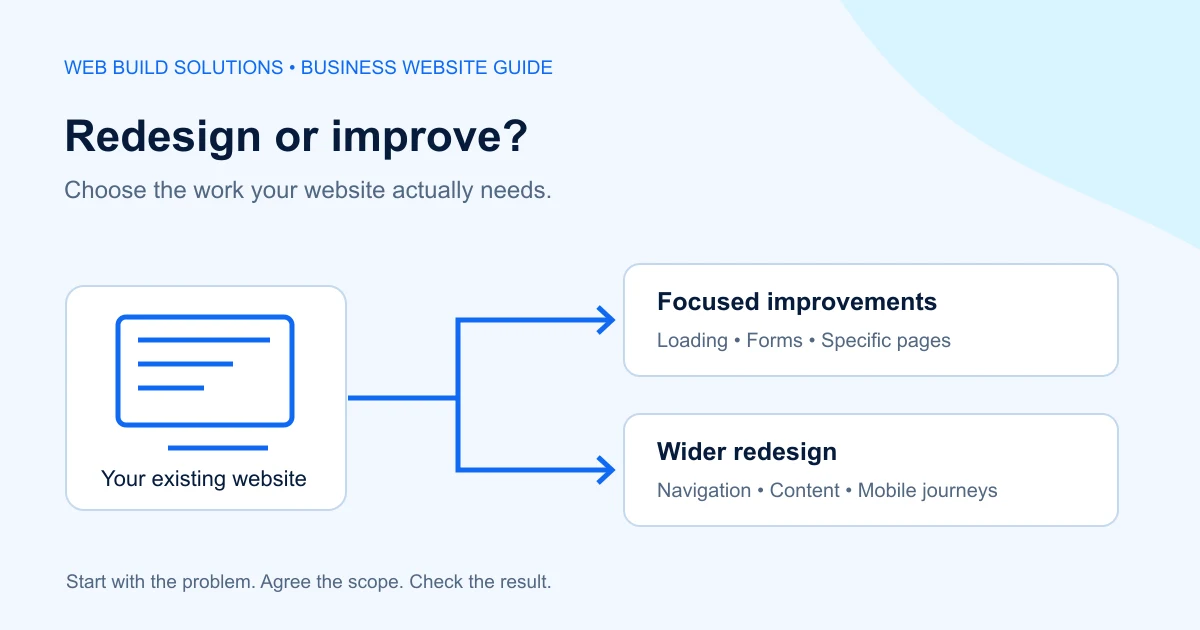
Choose targeted improvements when your website still explains your services well and the problems are limited to particular pages, loading or enquiry forms. Consider a redesign when navigation, content and mobile layouts repeatedly make the website difficult to use. First check that enquiries can reach you and that the right people are visiting; a new design alone cannot establish demand.
Your website is online, but enquiries are quiet. A customer says it feels slow on their phone. You are considering a new design, yet you do not know whether the existing site needs replacing.
Start by separating the problems. A dated appearance, a slow page and a missed enquiry can need different work. This guide helps you prepare a useful decision rather than commit to a rebuild before the cause is clear.
First, check whether enquiries can reach you
Send a labelled test through the website form and confirm that it arrives where the team expects it. Check the phone and email links on a mobile device. If you offer chat, confirm who receives its notifications and who follows up.
A working confirmation screen does not by itself prove an email reached your inbox. Fix a delivery problem before judging the website by the number of messages you receive. If leads are reaching different inboxes or being missed, read our lead capture and follow-up guide.
Decide which problem you are paying to solve
| What you observe | A sensible first discussion |
|---|---|
| Services are clear, but a few pages load slowly | Measure those pages and consider targeted performance work |
| Customers cannot find the right service or next step | Review navigation, page content and enquiry placement |
| Mobile layouts, navigation and content need changes across the site | Discuss a wider redesign scope |
| Forms work, but few relevant people visit | Review audience, positioning and discovery as well as the website |
| The site is difficult to update or depends on unsupported components | Review the CMS and maintenance requirements before choosing the approach |
These are starting points, not a diagnosis. One website may need several of them addressed together.
When targeted improvements may be enough
Keep a useful foundation when your services are understandable, important pages are current and customers can navigate the site. The initial scope might cover oversized images, specific loading problems, a confusing service page or an unnecessarily difficult form.
Ask what the proposed change addresses, which pages it covers and what remains outside the scope. For a loading issue, our slow website checklist explains what to bring to the discussion.
When a redesign becomes the more useful option
A broader redesign can make sense when customers repeatedly struggle across the site: navigation hides key services, content describes an old business offer, mobile layouts are difficult to use, or each small change exposes another structural problem.
The work should cover the customer journey as well as appearance. Agree how visitors will understand your services, assess your work and contact you. Keep useful existing content and identify integrations that must continue working.
If URLs will change, plan corresponding destinations and redirects before launch. Google recommends preparing a URL mapping and monitoring the transition. A redesign is not a reason to redirect every old page to the homepage.
Read performance evidence carefully
Ask for the pages tested, test date and relevant conditions. Controlled lab tests help investigate specific problems; field data reflects actual visitors across their devices and connections. The two can differ.
An improved lab score is useful evidence about a test, but it is not proof of additional enquiries or the same experience for every visitor. Agree both technical checks and practical checks such as completing a mobile enquiry.
A project example: Yukt Law Offices
Our Yukt Law work combined a website revamp with performance work, hosting, SSL, backups and continuing maintenance. The published case study includes supplied mobile PageSpeed Insights screenshots and explains their conditions and limitations.
Read the Yukt Law case study and original test evidence. Use it to assess the delivered work, rather than assume the same score or business result for another website.
What affects the quotation?
The amount of work depends on page complexity, content changes, CMS condition, forms, integrations, hosting constraints and any migration. Clarify who supplies copy and images, who approves the work and what happens after launch. Third-party fees and ongoing support should be identified separately.
For international projects, include your country and time zone so review meetings and communication can be agreed. Do not assume that remote delivery includes round-the-clock support.
What should you send us?
Share your public website URL, the main problem, the pages customers use most and any timing constraints. Explain whether the priority is loading, mobile usability, clearer services or a better enquiry process. Public links and general context are enough to start; do not send passwords or private customer records.
Discuss your website with Web Build Solutions. We can explore whether website redesign, performance improvements or a smaller agreed scope is the appropriate next step.
Common questions
Do I need a redesign because my website is slow?
Not necessarily. Images, scripts, hosting and third-party tools can contribute to slow loading. Ask for a baseline and a review of representative pages before deciding whether the structure needs replacing.
Will a redesign guarantee more enquiries?
No. Your offer, audience, traffic, credibility and follow-up also matter. Agree which customer journeys will improve and how you will assess them without treating a lab score as a sales result.
Can I keep my content and existing URLs?
Useful content and URLs should be reviewed before work starts. Preserve them where suitable and map any changed URLs to relevant destinations, with redirect and launch checks included in scope.
Sources and project context
- Google Search Central: Planning URL changes and site moves Checked 24 October 2026
- web.dev: Why lab and field performance data can differ Checked 24 October 2026
- Yukt Law Offices: redesign and continuing website care Web Build Solutions project record
Turn the question into a clear next step.
Tell us about your current setup, the people using it and what needs to improve.