
The short answer
A website redesign takes as long as its agreed scope and dependencies require. The build, content, approvals, access and integrations all affect the schedule. Ask for milestones tied to your website and acceptance checks, with a clear transition plan, rather than treating an effort estimate as a guaranteed launch date.
You want the new website ready for a campaign, a service launch or the start of a busy season. One provider gives you a short schedule; another asks for more time. Before comparing the dates, check what each proposal includes and what must be supplied by your team.
A website redesign timeline depends on the existing site, the changes required and the readiness of the people and material involved. A small visual update with approved content has a different scope from replacing a catalogue, changing the editing system or connecting a booking service. A useful proposal explains those differences and shows how they affect the launch.
Ask for a schedule based on your website and requirements. Here is how to assess it, prepare your part and keep business continuity in the plan.
Define what the launch must include
Start with the customer tasks the new site must support. A visitor may need to compare services and send an enquiry. Another business may need product search, payment and an order record for staff. Write down which tasks must work in the first release.
Then identify the pages, templates and connections needed to support them. Ten pages using an agreed service template are a different task from ten pages with different layouts, data and approval needs. Page count is useful, but it cannot describe the whole job.
Decide whether the existing platform, page addresses and editing process will remain. Replacing these can introduce migration and handover work. If you are still choosing between focused improvements and a wider rebuild, use our website review guide first.
The proposed launch should have a written scope: what is included, what is deferred, who supplies each input and what counts as acceptance. Our redesign brief checklist helps collect those requirements.
Separate working time from elapsed project time
A developer's estimate of implementation effort is not the same as a committed launch date. The calendar also includes content preparation, reviews, access requests, external dependencies and checks after changes.
Ask when the delivery estimate starts. Is it from signing the proposal, the kickoff meeting, receipt of the deposit or approval of the content and design? Confirm which conditions must be met for the stated date to remain realistic.
Some work can run in parallel. The team can prepare content while agreed templates are built, or assess integrations while the navigation is reviewed. That overlap needs coordination: a new content requirement can change a template, and an integration limitation can change the design.
Planning the launch
Ready to build is only one part of ready to launch.
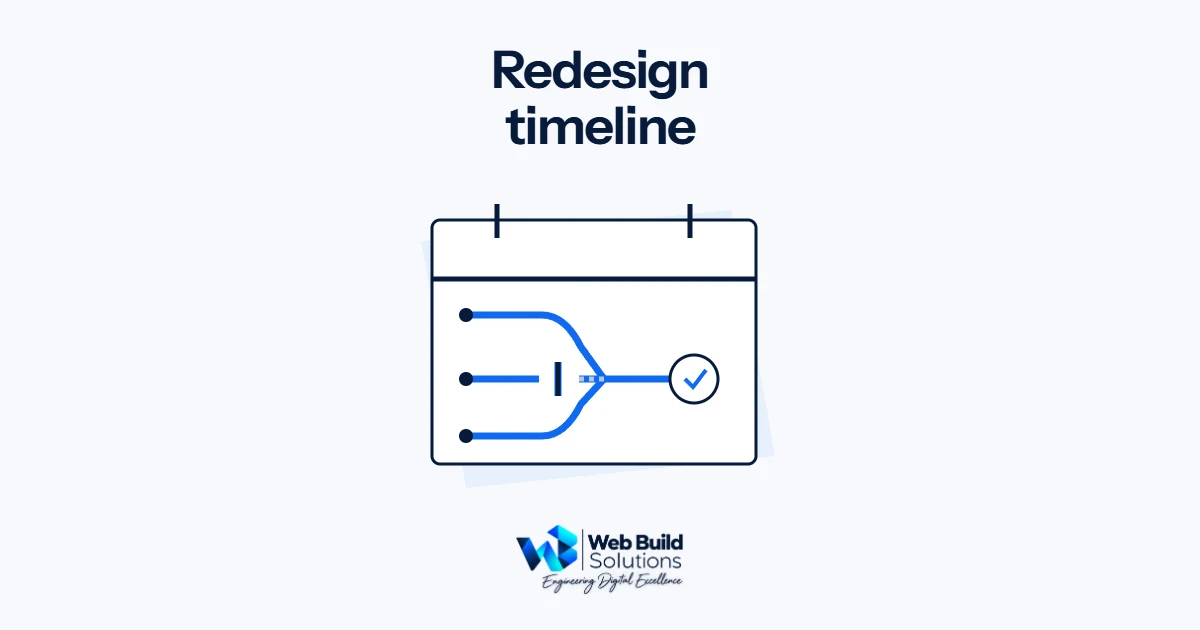
- Work can overlap
- Build, content preparation, decisions and access can progress alongside one another where the scope allows.
- Required inputs meet
- In this example, content approval is outstanding. Finishing the build does not make the required content ready.
- Then check and transition
- Complete the agreed acceptance checks and resolve blocking issues before the production switch.
A missing prerequisite can hold a milestone even when other work is complete.
For example, suppose the agreed templates are built but the service descriptions are awaiting approval. The developer may still have other useful work to do, yet the final pages and their customer journey cannot be accepted as complete. Record the outstanding decision and its owner, then revise the affected milestone together.
This is also why a progress percentage can be misleading. A nearly complete design does not tell you whether the enquiry reaches the right team or whether the remaining content is ready.
Agree the decisions that unlock the next stage
Use milestones that a business owner can recognise. A practical sequence might include:
- Scope agreed: priority customer tasks, pages, platform decisions and responsibilities are written down.
- Structure and representative design accepted: navigation, real content and important page states have been reviewed.
- Required content and functions ready: the release includes the agreed pages, assets, editing controls and connections.
- Acceptance checks complete: the team has tested the agreed journeys, addressed blocking issues and recorded remaining limitations.
- Launch and handover completed: the production transition, access, support responsibilities and initial checks are documented.
These are suggested milestones, not a fixed WebBuild package or an industry duration benchmark. A specific project may need different gates. Ask what you will receive at each milestone, who can approve it and what happens when feedback changes the agreed scope.
Choose one person to consolidate feedback from your team. Give reviewers enough context to decide: the task, the current version and the specific questions needing an answer. Conflicting comments need a decision rather than separate instructions passed to the developer.
Prepare content and access early
An approved homepage does not supply the service details, product data, policies, photographs or contact information for the rest of the site. Assign an owner to each required content group and agree when it is needed.
Mark material as approved, needing revision or still missing. Explain who can confirm factual claims and permission to use photographs, logos or testimonials. Avoid treating temporary text as launch-ready because it fills the layout.
Collect the account access needed for the agreed work through an appropriate secure handover. The domain, hosting, CMS, business email and third-party tools may belong to different accounts. Confirm ownership and available permissions; do not assume a hosting login includes everything.
Our content audit guide and developer handover checklist cover those tasks in more detail. Resolving them early gives the proposed schedule firmer foundations.
Allow for integrations and migration checks
Booking tools, payment services, CRM connections and property feeds can introduce requirements outside the page design. Identify the provider, account owner, permissions and supported test arrangements before setting a launch dependency on them.
For a store, agree how checkout and order handling will be tested. Shopify's guidance explains that test orders can check checkout and operational settings, and warns that customers cannot place live orders while payment providers are in test mode. Use the provider's supported procedure and an agreed environment; do not casually switch a trading site into test mode to meet a deadline.
If page addresses change, migration work belongs in the schedule. Google recommends mapping old URLs to relevant new destinations, implementing redirects and monitoring the move. It also recommends changing one thing at a time where practical. A redesign does not always require URL changes; keep useful addresses where they still make sense.
The SEO migration guide explains those responsibilities. Publishing the site and Google processing its changes are separate events. A launch date cannot guarantee when rankings, snippets or new images will update.
Plan how the current website keeps working
Ask whether development will happen on a separate review version and how that version is protected. The business should know which site customers are using, which version reviewers are checking and who can publish changes.
Agree how updates made to the current site will reach the replacement. A news item, changed price, new enquiry or order received during development must not disappear because the redesign began from an older copy. The required approach depends on the site's data and how frequently it changes.
Before the production switch, settle the transition window, responsible person, backup and recovery approach, checks and contact for urgent problems. Identify any temporary restrictions the business needs to understand. Keeping the existing site available during development is a planning goal, not a zero-downtime guarantee.
Recovery also needs a data plan. Switching visitors back to an earlier website does not automatically preserve new enquiries or orders received on the replacement. Ask how the team would account for those records before agreeing the release procedure.
Protect checks when the deadline is fixed
If the date cannot move, discuss a smaller first release. Prioritise the customer journeys and information needed for that occasion. A later release might add a nonessential section, another language or an integration that is not required for the first launch.
Check that the reduced scope still works as a complete experience. A service page needs accurate information and a usable next step; an unfinished payment journey should not be presented as a working shop.
Keep time for review and corrections. Check important tasks on mobile and desktop, form delivery, links, editing, content accuracy and relevant accessibility requirements. W3C's preliminary checks are a useful starting point, but passing a short checklist does not establish full accessibility.
Use our staging review guide for the review process. Record which issues prevent launch, which can follow later and who accepts that decision. Do not silently remove checks to recover time.
Compare proposals using the same assumptions
When two schedules differ, ask each provider to explain:
- What the first release includes and what is outside it.
- Which content, access and approvals are expected from your team, and by when.
- What can proceed in parallel and what must wait for another decision.
- Which integrations, migration tasks and external approvals are included.
- How feedback rounds, scope changes and missed inputs affect the dates.
- What acceptance, transition, handover and initial support are included.
A shorter proposal may cover less work, depend on more prepared material or have a different delivery approach. Those differences deserve examination before deciding which schedule fits your business.
Ask for the agreed milestones and assumptions in the proposal. When a dependency changes, request the impact on scope, cost and launch date together so your team can make an informed choice.
Ask for a schedule based on your website
If you are planning a website redesign, share the current website URL, the changes you need, the customer tasks that must work and your preferred launch date. Explain what makes the date important and which content is already approved.
We can discuss the requirements and the work needed to propose a suitable scope and schedule. Use the project enquiry form to send those details. The assessment should establish what is feasible before a delivery commitment is made.
Sources and scope
Sources checked on 16 November 2026:
- Google Search Central: site moves with URL changes.
- Shopify: placing a test order.
- W3C WAI: preliminary accessibility checks.
The milestones and preparation recommendations are editorial guidance. The illustration shows a hypothetical dependency, not a measured project schedule. This guide does not state a typical WebBuild delivery duration or guarantee uninterrupted service, rankings or commercial results.
Tell us about your project
Start with your details. We’ll discuss the right next step.
Questions covered in this guide
Can you give a redesign timeline before reviewing the website?
An initial discussion can identify the intended scope, but a useful delivery commitment needs the current website, required changes, content readiness, integrations and review responsibilities. Ask which assumptions the proposed dates depend on.
Can the existing website stay live during a redesign?
Development can be planned on a separate review version while customers use the current site. The production switch, changing content and new enquiries or orders still need an agreed transition and recovery plan; continuous availability cannot be assumed.
What if we have a fixed launch date?
Agree the customer tasks and content required for the first release, then consider deferring nonessential work. Keep acceptance and transition checks in the plan. The provider should explain whether the reduced scope and available inputs make the deadline feasible.
Does launching the redesign mean Google has updated every result?
No. Publishing the website and Google crawling and processing changes are separate events. Map and redirect changed URLs where needed, verify the production site and monitor the move; do not treat a launch date as a search visibility guarantee.
Sources and project context
- Google Search Central: site moves with URL changes Checked 16 November 2026
- Shopify: placing a test order Checked 16 November 2026
- W3C WAI: preliminary accessibility checks Checked 16 November 2026
Turn the question into a clear next step.
Tell us about your current setup, the people using it and what needs to improve.